One thing I'm all for is the world of open on the web. I can't be bothered with registering, subscribing and paying. Surely the whole point of the net is to have everything at your fingertips? Who wants to jump through all those hoops?
I'm a big fan of FileHippo. Many of the programs I've downloaded are open source. I'm not crazy about the whole open source movement (I take a practical approach rather than an ideological one), but I fully support anything to do with open source and open data. With freedom of information, it makes it a whole lot more practical to make everything available online instead of spending hundreds of man hours working through request after request. Not to mention the advantages of creating RDF schemas for such data and creating huge mashups of information.
On a personal level, open source comes a lot into my everyday life creating for the Sims. There is a big divide in the community about being 'fileshare friendly', or choosing to withhold or charge for the content you have created. This goes not only for custom items, skins and objects, but also for custom programs made to get the most out of the game. It is a very contentious issue, and still divides the community after many years. It seems that open source is something that people feel strongly about on both sides of the divide.
Sharing my creations freely is, for me, being part of an online community to get the best out of your game. Also, the ability to push the boundaries with your creations and 'show off' what you can achieve is also a big motivation. It is also a great way for creators and users to share their ideas and needs, to look outside the box and to create things from a whole new viewpoint. Creators create in response to other player's needs as well as their own. This makes the community atmosphere very productive, stimulating and open-minded. And more often than not, people are passionate enough about a service to donate in order to cover costs, so it works both ways.

Ludi's thoughts on the world of Library and Information Science
Showing posts with label semantic web. Show all posts
Showing posts with label semantic web. Show all posts
Sunday, 4 December 2011

Friday, 25 November 2011
The journey into Web 3.0....
I'd always read of the semantic web as Web 2.0. So it was a surprise to come across the concept of Web 3.0. Actually, the term 'semantic web' has been bandied around for a long time. What it actually is is up for debate. The easiest way to think about it is in terms of Web 1.0 = read only, Web 2.0 = read/write, and Web3.0 = read/write/execute.
What I take from the concept of Web 3.0 is the idea of making machines smarter, more 'intuitive'. Of course, since computers are inherently stupid, this involves us giving the means with which to become smarter and more intuitive. Like giving them the semantics to work with, in order to retrieve data more effectively. In short, data is not only machine readable, but machine understandable.
This is all technically theory, since the semantic web doesn't really exist - yet. We still don't really have a system whereby computers can build programmes, websites, mashups, what have you, in an intelligent and 'intuitive' way according to our needs. But the potential is there, with tools like XML and RDF. These involve the creation of RDF triples, taxonomies, and ontologies. What the hell, you may ask? And I may well agree with you. How I've come to understand it is that these are essentially metadata applied to information in order to relate those pieces of information together in a semantic way. These relationships between data or pieces of information make it easier to retrieve them, because they are now given a context within a larger whole.
This does have its parallels with Web 1.0. RDF Schemas (taxonomies expressed as groups of RDF triples) have a certain similarity to the concept of relational databases. RDF schema 'nodes' can be equated to the primary key in relational databases. In fact, the whole idea of RDF schemas can get a little confusing, so some of us found it easier to think of it in terms of a web-based relational database.
The idea behind this is essentially to create relational databases on the net, but to link them semantically to one another, effectively creating the ability to find correlations between vast amounts of data that would otherwise be remote and essentially invisible. The advantage is that we can get the accuracy of data retrieval results on the Web. To take the diagram's example; we have a database of student's GCSE results. If we pair this up with a demographic database, and apply an ontology to them (thereby creating rules of inference), we can discover correlations between GCSE results and student demographics.
The potential to make even more advanced and relevant mashups is the huge advantage of this technology. However, the problem is that it requires quite a bit of skill and time investment in order to create these schemas, taxonomies and ontologies. Most people would be satisfied with what they can create via Web 2.0 technologies - with social networking, blogging and mashups. The potential to make faulty schemas is also a problem - as with a database, any error in organising the information, or in the data retrieval process will mean a complete inability to access data.
But the main problem I see is that these schemas are only really applicable to certain domains, such as librarianship, archiving, biomedics, statistics, and other similar fields. For the regular web user, there are no particular benefits to applying an RDF schema to, say, your Facebook page - but it would probably be useful to Mark Zuckerberg.
The semantic web is probably more useful in the organisation of information on the web, and harnessing it. But it would probably be largely invisible and irrelevant to the legions of casual web users out there.
What I take from the concept of Web 3.0 is the idea of making machines smarter, more 'intuitive'. Of course, since computers are inherently stupid, this involves us giving the means with which to become smarter and more intuitive. Like giving them the semantics to work with, in order to retrieve data more effectively. In short, data is not only machine readable, but machine understandable.
This is all technically theory, since the semantic web doesn't really exist - yet. We still don't really have a system whereby computers can build programmes, websites, mashups, what have you, in an intelligent and 'intuitive' way according to our needs. But the potential is there, with tools like XML and RDF. These involve the creation of RDF triples, taxonomies, and ontologies. What the hell, you may ask? And I may well agree with you. How I've come to understand it is that these are essentially metadata applied to information in order to relate those pieces of information together in a semantic way. These relationships between data or pieces of information make it easier to retrieve them, because they are now given a context within a larger whole.
This does have its parallels with Web 1.0. RDF Schemas (taxonomies expressed as groups of RDF triples) have a certain similarity to the concept of relational databases. RDF schema 'nodes' can be equated to the primary key in relational databases. In fact, the whole idea of RDF schemas can get a little confusing, so some of us found it easier to think of it in terms of a web-based relational database.
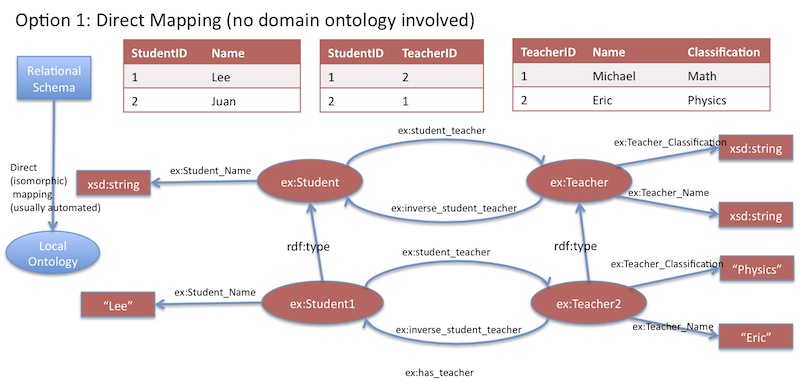 |
| Relational database <-> RDF schema |
The potential to make even more advanced and relevant mashups is the huge advantage of this technology. However, the problem is that it requires quite a bit of skill and time investment in order to create these schemas, taxonomies and ontologies. Most people would be satisfied with what they can create via Web 2.0 technologies - with social networking, blogging and mashups. The potential to make faulty schemas is also a problem - as with a database, any error in organising the information, or in the data retrieval process will mean a complete inability to access data.
But the main problem I see is that these schemas are only really applicable to certain domains, such as librarianship, archiving, biomedics, statistics, and other similar fields. For the regular web user, there are no particular benefits to applying an RDF schema to, say, your Facebook page - but it would probably be useful to Mark Zuckerberg.
The semantic web is probably more useful in the organisation of information on the web, and harnessing it. But it would probably be largely invisible and irrelevant to the legions of casual web users out there.
Subscribe to:
Posts (Atom)