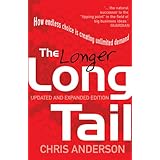
I picked up this book randomly in Waterstones the other day, trying to use up the points on the gift card my work colleagues had thoughtfully bought me as a leaving present. I remembered hearing about the 'Long Tail' on the LISF module, and figured it would be relevant reading.
The idea of the Long Tail isn't new, and is probably old hat to most readers. This book is an updated version of Chris Anderson's 2006 original, but to be honest, I don't think there was much added between the two editions. Most of the information was pertinent to pre-2006, and this edition happens to be 2009, so it's still a little out of date. For instance - no mention of Twitter, Spotify, and other newer social media. Not even last.fm, come to think of it. The thing is, you don't really need to have those sites mentioned. Anderson gives you all the detail, and you just run with it. Really, you could read 'Twitter' for 'Facebook' and you'd still get the same idea. The theory of the Long Tail would still hold true.
And really, that's the only beef I have with this book. Much as I enjoyed it (and I tell you true, I did), most of it was repetition. After the first couple of chapters, you'd pretty much got the point and were ready to move on. There is a Long Tail for just about anything you can think of - music, movies, coffee, chocolate, beer, clothes, prams, cars, advertising. After finishing this book, you will be wondering what ISN'T affected by the Long Tail and finding yourself hard-pressed to find anything.
The thing is, once you know it, it's obvious. We all have niche interests. There's nothing amazing about that. It's just that, with the internet, we have been spoiled by the expansion of opportunities to indulge in those interests. Perhaps for the first time in history, people have had wide access to niche markets open up before them at the click of a mouse. In the past traditional 'bricks and mortar' stores have only concentrated on the hits and the bestsellers because they had no space for the rare and the obscure, and the hits were sure to sell and make a profit. Simple math. Anderson's point is that this paradigm is dying - because of the World Wide Web. Now the niche market constitutes a growing proportion of a company's overall profits - and it's continuing to grow. If you have enough buyers in any one niche market, you are still going to make a hell of a lot of money, even if only one unit is sold per annum.
(Incidentally, this is one of the things I enjoyed most about being in Japan, specifically Tokyo. Stores there heavily cater to Long Tail markets. Yellow Submarine serves the long tail of roleplay gaming; Mandarake serves the long tail of self-published fan comics; Book Off serves the long tail of second hand books, CDs, DVD's and videogames).
Some people have criticised Anderson for not getting the economics right in this book; I don't know much about economics, but I know enough from what being a Long Tail consumer myself informs me. There is no way I could've bought VS System cards a year after they'd been discontinued without access to specialist online stores such as the 13th Floor. Neither could I have found the hard-to-find beads and findings I was looking for unless I went to great expense to get them specially shipped - or bought them cheaply and conveniently at The Bead Shop. A whole new world has opened up for me and my interests through the internet; as has a whole new market been born for many businesses out there in the 'real world'.
So yeah. It's worth a read. Even if only to get your brain ticking over all the Long Tails it can possibly conceive of.
Blog for my creative musings
Showing posts with label LISF. Show all posts
Sunday, 19 February 2012
Monday, 26 September 2011
Information/Library Sciency...Stuffs?
Well, as they say, "You learn something new every day", and today, on my first day of the MA/MSc Library Science course, I learned some really random stuff that everyone should know but most people don't. Like a byte is made up of 8 bits, and so therefore a kilobyte is 1024 bytes, and a megabyte is 1024 kilobytes and so on.
To everyone who knows all this already, and who are sniggering behind their sleeves at me... Yeah. I admit it. I was one of those dumb people who actually believed that a kilobyte is 1000 bytes. But hey, what is my first Library Science class for, if not to learn the BASICS of the BASICS. You'd think that since I spend half my life online, I'd know all this stuff already. But I realised, sometimes you get so immersed in something, and it becomes so much a part of your life, that you don't really stop to think about the ins and outs and how things work. It's a bit like language. How often do you think about grammar, or the letters that make up the words you say and why they're arranged that way? So today, I really learned for the first time about the 'letters' of digital information - bits and bytes, and files and formats.
Random stuff (for me) to keep a note of:-
The easier part of the Digital Information Technology & Architectures class was actually making a web page with all the links and the images and such. I'm much more comfortable with the doing than I am with the theory (except when Blogger decides it hates me :p).
Next up - Library & Information Science Foundation... Well, that's a pretty nebulous title. I didn't quite know what to expect. The last thing I was expecting was history - one of my fave hobbies! Lyn gave an awesome and informative lecture on the history of information, documents and writing. We kind of take it for granted that we live in a proverbial sea of information, something that surrounds us and is just 'there'. But where did it all begin, and when did it start be organised? And how? From cave paintings to scrolls, from the telegraph to the World Wide Web, the creation of information is a journey that is still going on, expanding, developing exponentially... And the big question is, how do we organise this proliferation of information? And that's where Library Science comes in. Fascinating stuff.
Which got me to thinking... history + libraries = the Library of Alexandria. A storehouse of ancient knowledge lost when it burned down somewhere between 48 BCE and 642 CE.
Think about all the priceless information we lost along with the library. Think of the glee of all those librarians had they ever had the chance to transcribe, archive and digitise all those documents. Sadly, they're all (mostly) gone - and therefore probably one less thing for us to worry about. :p
To everyone who knows all this already, and who are sniggering behind their sleeves at me... Yeah. I admit it. I was one of those dumb people who actually believed that a kilobyte is 1000 bytes. But hey, what is my first Library Science class for, if not to learn the BASICS of the BASICS. You'd think that since I spend half my life online, I'd know all this stuff already. But I realised, sometimes you get so immersed in something, and it becomes so much a part of your life, that you don't really stop to think about the ins and outs and how things work. It's a bit like language. How often do you think about grammar, or the letters that make up the words you say and why they're arranged that way? So today, I really learned for the first time about the 'letters' of digital information - bits and bytes, and files and formats.
Random stuff (for me) to keep a note of:-
- Formats can be interoperable, but most often are not.
- What's the difference between files and documents? Files = named collections of related digital information. Documents = a build up of information using different files, e.g. a blog entry incorporating text, images, videos etc.
The easier part of the Digital Information Technology & Architectures class was actually making a web page with all the links and the images and such. I'm much more comfortable with the doing than I am with the theory (except when Blogger decides it hates me :p).
Next up - Library & Information Science Foundation... Well, that's a pretty nebulous title. I didn't quite know what to expect. The last thing I was expecting was history - one of my fave hobbies! Lyn gave an awesome and informative lecture on the history of information, documents and writing. We kind of take it for granted that we live in a proverbial sea of information, something that surrounds us and is just 'there'. But where did it all begin, and when did it start be organised? And how? From cave paintings to scrolls, from the telegraph to the World Wide Web, the creation of information is a journey that is still going on, expanding, developing exponentially... And the big question is, how do we organise this proliferation of information? And that's where Library Science comes in. Fascinating stuff.
Which got me to thinking... history + libraries = the Library of Alexandria. A storehouse of ancient knowledge lost when it burned down somewhere between 48 BCE and 642 CE.
![]() |
| ONLY A RECONSTRUCTION. NOT THE REAL LIBRARY OF ALEXANDRIA. |
Subscribe to:
Posts (Atom)

