Showing posts with label history. Show all posts

Wednesday, 21 March 2012

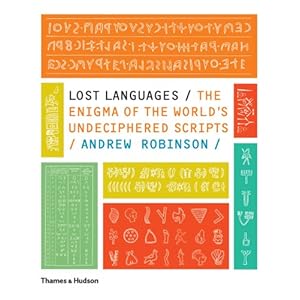
From the Shelf: Lost Languages by Andrew Robinson

I happen to have a thing about historical mysteries, and I also happen to have a thing about the history of writing.  These two interests of mine seem to have come together admirably in Andrew Robinson's Lost Languages: The Enigma of the World's Undeciphered Scripts.

'Lost Languages' is a bit of a misnomer in this case.  'Lost Writing Systems' would've been a more accurate if less poetic title.  While lost languages often walk hand in hand with lost writing systems, that isn't always expressly the case, as Robinson makes clear.  For example, the famous case of the decipherment of Linear B showed that the Linear B tablets recorded a very archaic form of Greek.  Likewise, ancient Egyptian hieroglyphs expressed a form of archaic Egyptian quite similar to Coptic, which was still a living (if only strictly liturgical) language.  This isn't a book about the lost languages, it's a book about lost writing systems (in the sense that their meaning is largely lost to us), and about attempts at decipherment.  What makes this book fascinating is how culture often seems to inform the decipherment of scripts.  As such, Robinson throws in a lot about the history of each culture, as well as the technical details of decipherment.  Robinson gives us a taste of the history of writing, bringing to life a human need that has spanned the ages.

This need is the need to organise, record and remember, and it is the single most fascinating thing about this book.  People say we now live in an 'Information Society'; but I believe that we always have, just in ways that have been limited by the available tools and infrastructure around us.  This desire to order and make sense of our world has led to the invention of many hundreds of different scripts, of varying degrees of complexity and efficiency (Robinson highlights the fact that Japanese is the most inefficient writing system in the world, yet Japan has one of the world's highest levels of literacy).  Throughout time, human ingenuity has been funnelled into the activity of writing and recording, even if it means re-inventing the wheel again and again.

The mysterious rongorongo script.
The most intriguing example of this is the rongorongo script of Easter Island, a relatively young script which died possibly within the space of 90 years.  No one knows exactly when it was invented or when it died out, what it was used for or what any of the beautifully cartoon-like characters mean.  But somehow, for some reason, someone on this isolated little island in the middle of nowhere felt the need to invent a complex script that flourished for a short time before its flame suddenly and dramatically died out with the coming of the slave trade and disease from the West.  And yet this writing system, constructed about the 18th-19th century, shares striking similarities with a totally unrelated system (The Indus Valley Script), which died out nearly 3 millennia before.

An Indus Valley seal.
What I found most enlightening about Robinson's book is the fact that nearly all the scripts he highlights were created not in order to create but to record.  There are no great epics or literary works to be found amongst the earliest records.  Nor are there mythologies, histories, or philosophies.  Most of the earliest writings deal with records, itineraries, calendars, and lists of people - slaves or kings.  What drove people to invent writing?  It was a need to record, enumerate and catalogue information.  To order our world, even to the most mundane degree.  That is what those first pioneers, the inventors of writing, bequeathed to us.  Their's was an information society as much as ours was, and Lost Languages gives an intriguing insight into the lost information societies of yesteryear.

Monday, 26 September 2011

Information/Library Sciency...Stuffs?

Well, as they say, "You learn something new every day", and today, on my first day of the MA/MSc Library Science course, I learned some really random stuff that everyone should know but most people don't.  Like a byte is made up of 8 bits, and so therefore a kilobyte is 1024 bytes, and a megabyte is 1024 kilobytes and so on.

To everyone who knows all this already, and who are sniggering behind their sleeves at me... Yeah.  I admit it.  I was one of those dumb people who actually believed that a kilobyte is 1000 bytes.  But hey, what is my first Library Science class for, if not to learn the BASICS of the BASICS.  You'd think that since I spend half my life online, I'd know all this stuff already.  But I realised, sometimes you get so immersed in something, and it becomes so much a part of your life, that you don't really stop to think about the ins and outs and how things work.  It's a bit like language.  How often do you think about grammar, or the letters that make up the words you say and why they're arranged that way?  So today, I really learned for the first time about the 'letters' of digital information - bits and bytes, and files and formats.

Random stuff (for me) to keep a note of:-

  • Formats can be interoperable, but most often are not.
  • What's the difference between files and documents?  Files = named collections of related digital information.  Documents = a build up of information using different files, e.g. a blog entry incorporating text, images, videos etc.

The easier part of the Digital Information Technology & Architectures class was actually making a web page with all the links and the images and such.  I'm much more comfortable with the doing than I am with the theory (except when Blogger decides it hates me :p).

Next up - Library & Information Science Foundation... Well, that's a pretty nebulous title.  I didn't quite know what to expect.  The last thing I was expecting was history - one of my fave hobbies!  Lyn gave an awesome and informative lecture on the history of information, documents and writing.  We kind of take it for granted that we live in a proverbial sea of information, something that surrounds us and is just 'there'.  But where did it all begin, and when did it start be organised?  And how?  From cave paintings to scrolls, from the telegraph to the World Wide Web, the creation of information is a journey that is still going on, expanding, developing  exponentially... And the big question is, how do we organise this proliferation of information?  And that's where Library Science comes in.  Fascinating stuff.

Which got me to thinking... history + libraries = the Library of Alexandria.  A storehouse of ancient knowledge lost when it burned down somewhere between 48 BCE and 642 CE.

ONLY A RECONSTRUCTION.  NOT THE REAL LIBRARY OF ALEXANDRIA.
Think about all the priceless information we lost along with the library.  Think of the glee of all those librarians had they ever had the chance to transcribe, archive and digitise all those documents.  Sadly, they're all (mostly) gone - and therefore probably one less thing for us to worry about. :p